Researchers Create Smaller, Cheaper Flow Batteries for Clean Energy

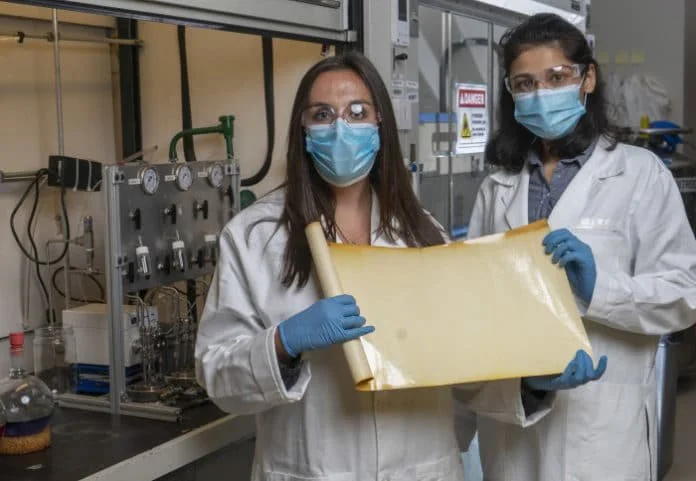
Existing flow battery technologies cost more than $200/kilowatt hour and are too expensive for practical application. The Lively and Liu labs developed a compact flow battery cell configuration that relies on hollow fibers for a sub-millimeter, bundled microtubular (SBMT) membrane.

The new design lowers membrane-to-membrane distance by 100 times, reduces the size of the cell by 75%, and ultimately decreases the size and cost of the entire flow battery. Read more in this news article, and check out the article in PNAS here.

First synthetic membrane to separate crude oil and crude oil fractions

Scientists from the Georgia Institute Technology, Imperial College London, and ExxonMobil have developed the first synthetic membrane to separate crude oil and crude oil fractions to reduce carbon emissions and energy use associated with refining crude oil. Tech technology substitutes the low-energy membranes for specific steps in the refining process. It is expected to contribute to a hybrid refining system that could help reduce carbon emissions and energy consumption significantly compared to traditional refining processes. Read more about it here.

New Membrane Could Reinvent Crude Oil Refining

Crude oil is a complex mixture of tens of thousands of organic hydrocarbon molecules, Separating them requires energy-intensive thermal distillation processes that consume about 1% of global energy. Researchers now report the first polymer membrane capable of splitting crude oil into separate parts, a much more energy-efficient approach. Check out the rest of the article here.

Associate Professor Ryan Lively Wins AIChE’s 2020 Colburn Prize

Ryan P. Lively, an associate professor and the John H. Woody Faculty Fellow in Georgia Tech’s School of Chemical and Biomolecular Engineering (ChBE), is the 2020 winner of the American Institute of Chemical Engineers’ (AIChE) Allan P. Colburn Award for Excellence in Publications by a Young Member of the Institute.

First presented in 1945, the Allan P. Colburn Award for Excellence in Publications by a Young Member of the Institute is awarded to an AIChE member in their early career. The award is sponsored by E. I. DuPont de Nemours and Company, Inc.  Each year, the award recognizes outstanding progress in the field of chemical engineering by one researcher in any area of chemical engineering research who is within 12 years of completing their PhD at the end of the calendar year in which the award is presented. One of the most prestigious awards an early career chemical engineer can be receive, the Colburn award recognizes significant advances and contributions to the field of chemical engineering. Read more about it here.

Georgia Tech Researchers Advise DIY Mask Makers with Advanced Aerosol Instrumentation

Since late March, a team of Georgia Institute of Technology (Georgia Tech) researchers have been providing recommendations for readily available materials to use as filters in homemade face masks. The “Rapid Response” team, which includes Georgia Tech faculty, research staff and students, is providing advice that includes its understanding of the chemical and mechanical properties of filter materials as well as results of tests conducted on advanced aerosol chemistry equipment from a climate change lab. 

Check out the rest of the story here.

Metal Oxide-infused Membranes Could Offer Low-Energy Alternative For Chemical Separations

Chemical manufacturers consume a massive amount of energy each year separating and refining feedstocks to make a wide variety of products including gasoline, plastics and food. In a bid to reduce the amount of energy used in chemical separations, researchers at the Georgia Institute of Technology are working on membranes that could separate chemicals without using energy-intensive distillation processes.

Check out the story here.

Darren Woods, the CEO of ExxonMobil, recently discussed Dr. Lively and Dr. Koh's work

Darren Woods, the new CEO of ExxonMobil, discussed academic-industrial partnerships, and highlighted the work ongoing in Dr. Lively's focusing on organic solvent reverse osmosis.  The remarks occurred at the 2017 CERAWeek meeting, which is a high-level annual energy conference where world leaders discuss emerging trends in energy technology, among other issues. (https://en.wikipedia.org/wiki/CERAWeek). Read the news article here